I thought I would share my knowledge of weirs. I guide fishing trips throughout south central Alaska and have operated well over a thousand trips on the Little Susitna and Deshka Rivers for the last 20 years. The Little Susitna River and Deshka River have weirs. I have an intimate knowledge of a fish weirs effects on salmon, because they play a major role in salmon movement. My job as a professional guide is to track salmon movement and know where salmon are and at what times based on conditions, run timing, fishing pressure, water temperature and many other factors. Understanding how weirs affect salmon migration is paramount in catching salmon on the Little Susitna and Deshka Rivers.
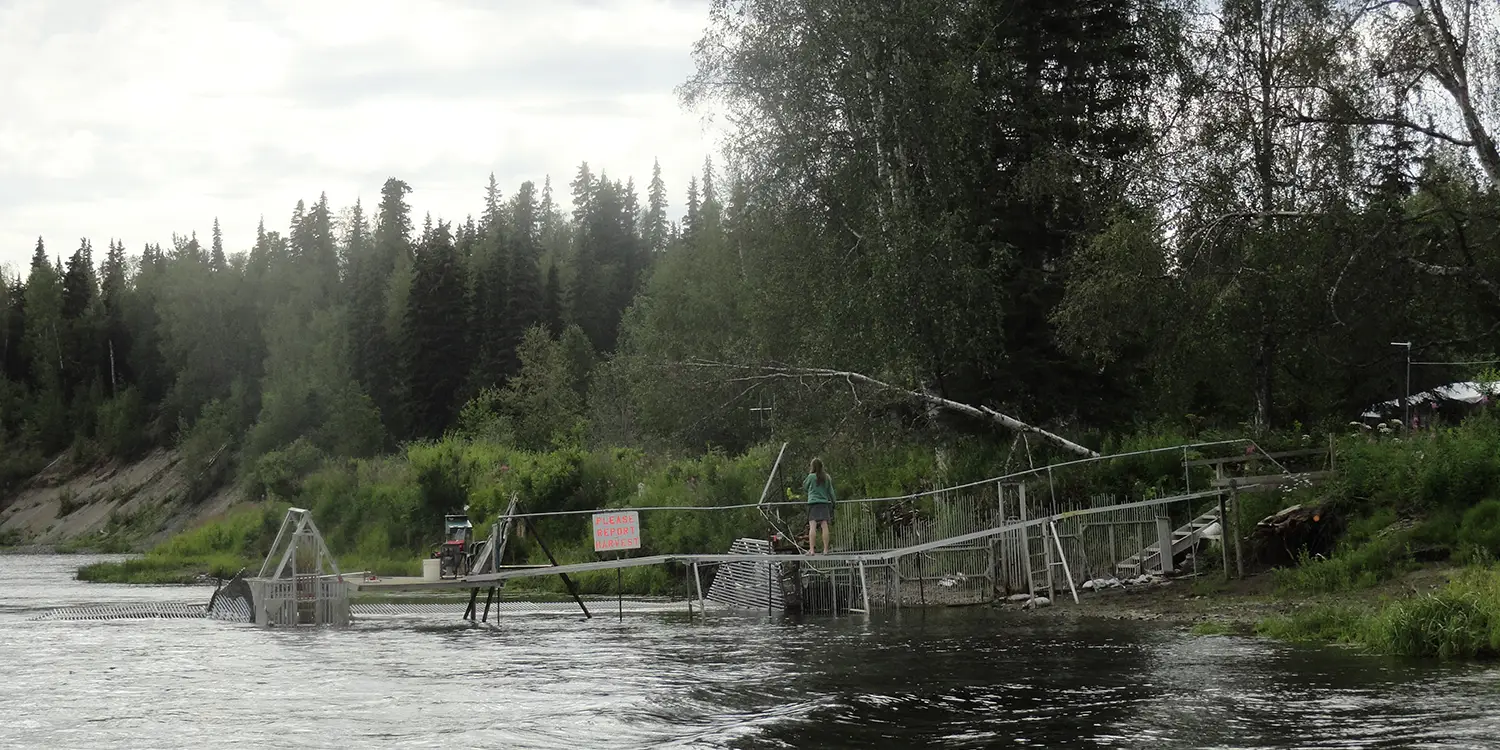
The Little Susitna river weir is located at river mile 32.5 (2012-2024) river mile 38.6 (2025). The Deshka river weir is located at river mile 7. A weir is a temporary fence (composed of pipe and cable) spanning the entire width of the river and blocks the whole river and restricts fish passage to a 2 foot wide slot with a door that a fish and game technician will open and close. If a technician is not on the viewing deck, the door is closed, this often occurs for several hours. In some instances video coverage, when resources are available, is utilized to count migrating fish when the door is open. Video count accuracy can be challenged by turbid water conditions that often occur. Weirs are used by Alaska Department of Fish & Game technicians and biologists to study migrating salmon as they migrate upriver. Operating a weir allows the Alaska Department of Fish and Game to acquire a daily and annual fish counts for the river. Fish counts are available on the Alaska Department of Fish and Game’s website. As salmon and other anadromous fish migrate through the weir they are counted manually by the technician who visually sees the fish as they rapidly swim over a white board, which helps the technician identify the species. I personally find it funny watching a technician attempt to count 8000 chum salmon that want to swim across at once.
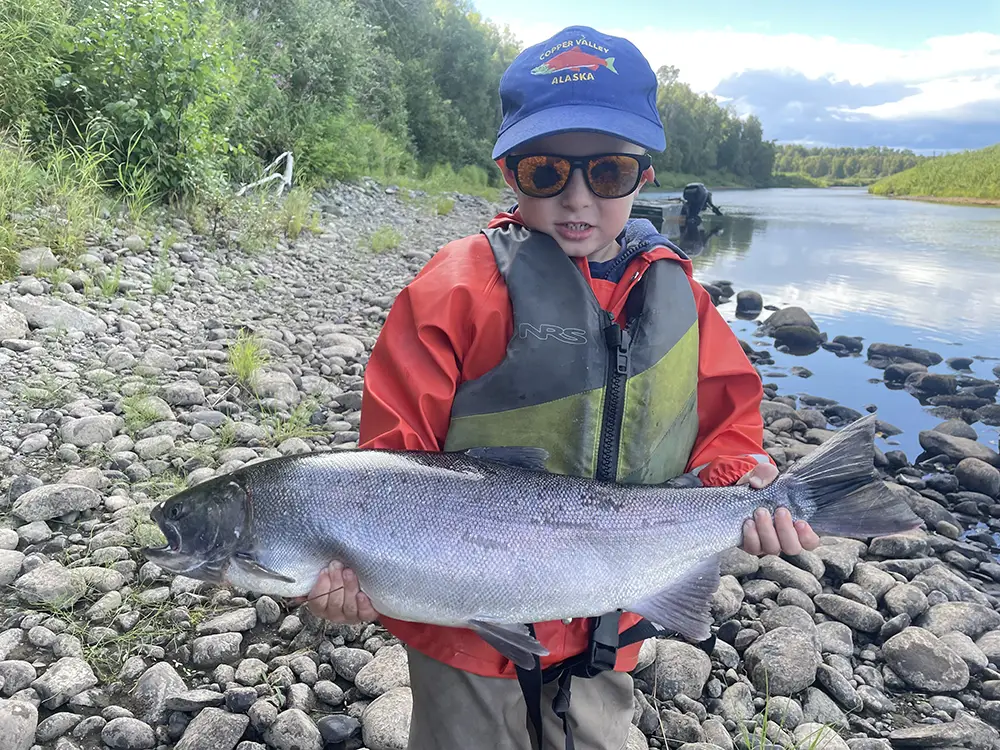
Salmon will stage below weirs in significant numbers, which is why the fishery is closed below the weir for approximately 300 yds on the Deshka and 600yds on the Little Susitna River. Salmon do not like weirs because they are foreign and a barrier to migration. Salmon will swim up to the weir and if they do not cross immediately, will travel downstream to the next available holding water. Salmon, especially Chinook will stage in the next 2 to 3 holes below the weir for several weeks. I am confident that in some instances Chinook will travel back down several miles below the weir to stage. If you think this sounds absurd, consider one of my Knik Arm set netter friends has caught Chinook with spin n glows and hooks in his set net in Knik Arm, not to mention another Little Su guide actually caught a Chinook in the Little Su with tags from the Fish and Game fish wheel on the Yetna River (that sounds crazy)- so a couple miles is completely believable. Once a salmon crosses the weir, the most common tendency is for that salmon to migrate upstream at an extremely fast pace and not hold for several miles. Back when the Deshka had large Chinook returns and on days when several thousand Chinook would cross the day before, you could not find those fish the next day anywhere between the weir and the marker at Chujik Creek 10 miles upstream. Right above the Deshka weir is one of the best looking Chinook holes on the whole river, but forget about consistently catching salmon there. Once salmon migrate through the weir, they typically will migrate hard and will not hold because they have been doing so downstream of the weir, possibly for several weeks in some instances. Peak Chinook movement on the Deshka River under normal mid June to early July water conditions is between 10pm and 2am. To me it is unclear what times technicians count or do not count fish. I have been on the river hundreds of times during prime migration times, with the fish passage gate closed and counting not taking place. Is it reasonable to expect a technician (often a college intern) to stare at a white board for 12 straight hours or for that technician to have the intuition to know when peak migration will be occurring for the day or to know when a 1000 random salmon just decided they wanted to cross the gate? A salmon that swims up to an impassable barrier in shallow low water, goes back downstream to the closest available holding water and stages for either a short or a very long time based on river conditions. I’ve always wondered if weirs have an effect on spawning distribution in the watershed, particularly the salmon that spawn in the upper reaches of the watershed. The tendency for Deshka Coho is to stage in the entire river below the weir for several weeks until a high water event. The Little Susitna Chinook and Coho movement is more variable and influenced by water temperature, clarity and level. On sunny and low water days, salmon are extremely reluctant to migrate over weirs mid day, that is why the slide hole right below the weir on the Deshka is often a good afternoon option, if you can get them to bite.
The Deshka and Little Susitna River weir fish counts can provide an in season management tool to some extent, depending on water conditions. The Little Susitna and Deshka Rivers have escapement goals for Chinook and Coho. The following link has a brief explanation of what an escapement goal actually is.
https://www.adfg.alaska.gov/index.cfm?adfg=wildlifenews.view_article&articles_id=123
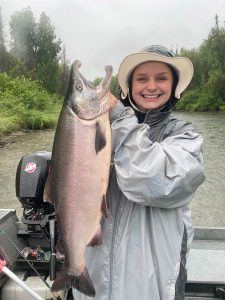 Escapement Goals:
Deshka River Chinook 9,000-18,000
Deshka River Coho 10,200-24,100
Little Susitna River Chinook 2,100-4,300
Little Susitna River Coho 10,200-24,100
Crossing the weir with a vessel is accomplished by idling over the fence very slowly at the designated spot between 2 buoys. A technician has the ability to lower the weir approximately 18” down to aid the vessel to glide over the top of the weir. As a boat operator, it’s important to understand, there could be loose cables and metal on the weir and these can pose a safety threat, if the weir is not crossed slowly. Also you do not want to hit the weir anywhere and cause damage that will have to be repaired for the weir to function properly. When approaching upstream I nose the bow of the boat on (or where the weir is lowered) smoothly then give it a little throttle and then glide over. When traversing downstream over the weir I get my vessel lined up and often, right when I cross kill the motor. This helps reduce noise and allows me to converse with the technician and share my observation on the river for the day.
2025 Little Susitna River and Deshka River weir management, maintenance, relocation, and installation was in my opinion a disappointment. ADF&G staff probably share this same opinion.
Check back on my website to read part 2; which will include more detail about the Little Susitna River and Deshka River weirs in the 2025 season. I look forward to sharing weir costs, funding, management, benefits and challenges.